Sunday, March 6, 2011

Turkish Businesses Blamed For Being a Part of “Nur” Movement in Uzbekistan

Turkish businesses are blamed for providing financial support to banned religious movements

Turkuaz supermarket

Almost 50 Turkish-owned businesses were closed in Uzbekistan to date. They are blamed for allegedly providing support to “Nur” movement, which the Uzbek government labels as a group that undermines constitutional order.

The latest incident happened on Wednesday, March 2, when a large number of law enforcement officers were brought to the “Turkuaz” supermarket in buses and the building was surrounded. After police forced the four-story supermarket to shut its doors, they rounded up all workers.

According to the source close to the Turkish embassy, the Uzbek law enforcement’s raid was described as a “terror”, in which all employees were ordered to lay down on the floor and the director of the store Vohid Gunesh was beaten in his office. Afterwards, Mr. Gunesh was taken to the hospital in an ambulance. Turkish embassy employees were not allowed to visit Mr. Gunesh the same day. Most of the goods from the store were loaded into trucks and taken away.

The closings follow a similar shutdown by law enforcement authorities of a popular Turkish-owned supermarket “Mir” in Tashkent in January. Both supermarkets are owned by the same holding company Sharq-MIR.

According to the BBC’s Uzbek service, on Thursday, March 3, the state television of Uzbekistan in a special program blamed that Turkish businesses took advantage of friendly relations between two countries and of a good investment environment  in the country and have hidden taxes from authorities.

According to the Uzbek state television, Turkish-owned businesses such as “Turkuaz”, “Gunesh” and “Kaynak” have disseminated literature related to the banned “Nur” movement and are behind establishing underground religious groups.

The Nurchilar, or Nurcular, Islamic movement is banned in Uzbekistan. It was founded in 1945 by a Turkish religious scholar Said Nursi, the movement encourages the combination of educational pursuits and religious devotion.

In a TV program it was said that more than 50 Turkish-run businesses were closed down and their assets of about 400 million Uzbek soums (about $300,000) have been confiscated and business leaders were called for a criminal investigation.

The Turkish embassy in Tashkent is not commenting regarding the incidents, but the source at the embassy said that Turkish diplomats are outraged. There were some raids before, but never been conducted in such a terrible manner.

Thursday, February 24, 2011

No Twitter revolt for Central Asia's closed regimes

High fees, spying, and outright blockage -- Central Asia's regimes are not short of ways to control Internet blogs and social networks which have mobilised the recent protests in the Middle East.
Strategies vary across the former Soviet republics of the region, whose regimes are largely authoritarian and where voicing dissent online can result in persecution.
In some countries, even getting online is an insurmountable challenge. Internet access at home became available in Turkmenistan only in 2008, and state provider charges $7,000 dollars per month for unlimited high speed access.
That is beyond reach for the vast majority of people in a country where monthly per capita GDP is just over 600 dollars. But even at that price, only the so-called "Turkmenet" is available: access to YouTube, Facebook, Twitter, and popular blogging platforms like LiveJournal are blocked.
Internet cafes have existed in the isolated energy-rich state since 2007, but customers have to show their passports to use them.
Media in Turkmenistan or neighbouring Uzbekistan have not highlighted the revolutions in Egypt and Tunisia, where mobilisation was largely possible due to the Internet.
US Assistant Secretary Robert Blake issued a soft warning last week during a visit to the region, marking the "importance of free media and other such mechanisms" in letting young people express themselves.
"It's important for leaders in relatively closed societies to heed the lessons, to listen to the lessons of what's happened in Tunisia and in Egypt," he said in Ashgabat.
That message has been ignored in Uzbekistan, ruled for more than two decades by President Islam Karimov, where tight control over the Internet was imposed after regime changes in Ukraine and Georgia in mid-2000s.
Any Internet user can be disconnected the moment his activities are deemed dangerous for the state. But disconnection is not the worst outcome for independent thinkers in Central Asia's most populous country.
A moderator of popular forum arbuz.com, which was created abroad and is critical of the regime, recently urged visitors to be careful after "some forum participants got arrested by the security forces in Uzbekistan for participating in this forum."
"You should NEVER under ANY circumstances attempt to open the forum when you are in Uzbekistan... I want you guys all to be safe and take my message very seriously," the message stated.
Warning signs at Internet cafes in the country openly say that "Visiting websites that contain anti-constitutional, religious extremist and pornographic contents are prohibited," and independent news websites are blocked.
"Despite the existence of new communication technologies, Uzbekistan remains largely isolated from the rest of the world," said rights activist Surat Ikhramov.
Rights watchdog Reporters Without Borders has named Uzbekistan and Turkmenistan among the 12 countries that are "enemies of the Internet," along with North Korea.
In Kazakhstan, the region's most prosperous country, where Nursultan Nazarbayev has ruled since 1989, Internet control has tightened with a 2009 bill naming every website a media outlet.
"The situation with the freedom of expression has worsened since 2009, and in 2010 there was the biggest degradation," said Irina Mednikova, coordinator of Kazakh movement "For Free Internet".
"Every website automatically becomes a media outlet, even blogs that don't require any registration," she said.
"Very often the government uses a standard method, where media criticizing the government are accused of absurd things, and after a series of court cases, fines, and arrests they simply close."
Kazakhstan's oppositional news website Respublika, the online TV channel KPlus-TV.net, and Internet radio Inkar, have been blocked, along with blogging platforms Kub.info and Livejournal.
"We constantly observe continued pressure on independent publications, of which there are no more than ten in the whole country," Mednikova said.


Antoine Lambroschini (AFP)

Sunday, January 9, 2011

Private Driving Schools To Close in Uzbekistan

Tashkent City Street


According to the RFE/RL's Uzbek Service, the government of Uzbekistan made an order that all private driving schools to close and that as of April, 1, 2011, all driver education will be conducted by Defense Ministry’s Vatanparvar (Patriot) branches similarly to the ones that existed during the Soviet’s rule.

Now, more than 130 private driving schools exist in Uzbekistan and this measure will definitely leave many people unemployed.

One owner of a driving school, Svetlana Aleksandrova, noted that “if the decision is not withdrawn, 12 of my employees will lose their jobs and you may count yourself how many people out there working in such schools will be jobless."

Driving school owners gathered in Tashkent, capital of Uzbekistan, on January 5 and filed a complaint about the government’s decision with the Union of Entrepreneurs of Uzbekistan. The owners noted that 2011 was proclaimed by the President Islam Karimov as the "year of small businesses and private entrepreneurship" and that such measures only hurt private businesses.

The government’s reason for closing private driving schools comes from the poor skills of graduates and an increase in road accidents. Many students do not regularly attend the driving lessons and pay bribes to receive their driver's licenses. So, the real issue might be with the Traffic Security Department of the Interior Ministry where a person goes for an exam, and often, pays the department employees through their driving school teachers to get through the exam. Consequently, the responsibility should be increased at the traffic security department so that only able students can pass the tests.

Accordingly, experts say that without eliminating corruption within the Traffic Security Department, the closure of private driving schools is meaningless as road accidents due to poor driving skills will continue to occur and the government's new plan will only worsen corruption.

Monday, January 3, 2011

U.S. - Central Asia Relations 2010

In 2010, the United States intensified its efforts to broaden relations with the five Central Asia countries: Kazakhstan, Kyrgyzstan, Tajikistan, Turkmenistan, and Uzbekistan.


Private U.S. companies are involved in oil and natural gas development in Kazakhstan and Turkmenistan.

In 2010, the United States intensified its efforts to broaden relations with the five Central Asia countries:  Kazakhstan, Kyrgyzstan, Tajikistan, Turkmenistan, and Uzbekistan. 

"The United States is seeking to expand its engagement with all of the Central Asian countries on all of the issues of concern to us," said U.S. Assistant Secretary for South and Central Asian Affairs Robert O. Blake, Jr.  "That means not only our common interests in Afghanistan but also how to expand trade and investment, and also how to work to improve human rights and democracy throughout Central Asia."

The U.S. is working with these countries to help support democratization and respect for human rights, and to promote open trade and free markets while helping to establish strong East-West and Central Asia-South Asia trade links.  The U.S. is also helping to reduce trafficking in persons, arms and illegal drugs, and cooperating to combat terrorism and nuclear proliferation, all of which have a destabilizing effect on society. 

The United States has tailored U.S. policy in Central Asia to the varying characteristics of each state. In Kazakhstan, we have helped to secure and eliminate Soviet-era nuclear and biological weapons, materials and facilities, signed a bilateral science and technology cooperation agreement, and urged the government to implement its National Human Rights Action Plan.

Private U.S. companies are involved in oil and natural gas development in Kazakhstan and Turkmenistan.  We have significantly increased U.S. humanitarian, health, and education assistance to Kyrgyzstan and Tajikistan, hard hit by the 2008 global economic down-turn.

The U.S. has strongly supported Kyrgyzstan’s recent transition to parliamentary democracy, and donated $100 million following the ethnic violence in the south last June to help to support stabilization, humanitarian needs, police reform and reconciliation as well as move the democratic processes forward.  

We also support the Turkmenistan-Afghanistan-Pakistan-India Pipeline, or TAPI, because, as Assistant Secretary Blake said, "We believe there is a great strategic logic in trying to link the oil and gas reserves of Turkmenistan with the large and growing energy markets of South Asia," he said.  At the same time, we continue to press the government of Turkmenistan to improve its human rights record.

We have deepened our economic and security relationship with Uzbekistan, while continuing to urge the Government to make progress on human rights and democratic reforms.

The United States appreciates the Central Asia nations' support of the multinational mission in Afghanistan.


Link to the article: http://www.voanews.com/policy/editorials/US---Ce-ntral-Asia-Relations-2010-112791629.html

Saturday, January 1, 2011

Uzbek human rights group claims 39 died of torture in prisons

MOSCOW (AP) — At least 39 people have died of torture in prisons of authoritarian Uzbekistan this year amid a spiraling crackdown on religious groups and government critics, a respected rights group said Thursday.

The Independent Human Rights Defenders Group said the figure was based on information from the victims' families and former inmates. It added that the actual number of such deaths could be higher, but many are not reported because the families fear official reprisals for contacting rights activists or reporters.

In 2009, the group registered 20 prison deaths by torture.
Prison authorities often return bodies to relatives in sealed coffins to conceal torture, the report said. Police officers force the families to ignore Muslim burial rites and bury the unopened coffins, it said.

"They bring the bodies late at night, tell the relatives to bury them at dawn and then patrol their houses for several days after the funeral," the group's chairman, Surat Ikramov, told The Associated Press.

Muslim law prescribes the washing of bodies and burials in a shroud.

Uzbek officials were not available for comment.

U.S.-based Human Rights Watch 
said in 2007 that Uzbek authorities routinely beat prisoners and used electric shocks, asphyxiation and sexual humiliation to extract information and confessions. A forensic report commissioned by the British Embassy concluded that in 2002 two jailed rights activists were boiled to death.

Dozens of rights and opposition activists have been jailed in Uzbekistan in recent years.

Worried by the revival of Muslim traditions and the threat of radical Islamism from neighboring Afghanistan, the government of former Communist boss Islam Karimov has for years suppressed peaceful Muslims who practice their faith outside government-approved mosques.

Ikramov said the number of peaceful Muslims that serve time in Uzbek jails approaches 10,000. "The number is always rising," he said.

His group said this year alone 370 Uzbeks, including dozens of women, have been convicted and jailed on trumped-up charges of membership in radical Islamic groups. It said the defendants are routinely tortured before they face closed trials. Once in jail, they face beatings and abuse from other inmates encouraged by prison authorities, the group said.

Other religious groups such as Protestants also face constant pressure in Uzbekistan, and several pastors have been convicted and jailed in recent years for allegedly preaching hatred against Muslims.

Karimov has ruled the predominantly Muslim nation of 28 million since before the 1991 Soviet collapse. His government had a falling out with the U.S. and other Western countries after a brutal suppression of an uprising in the eastern town of Andijan in May 2005.

Witnesses and rights groups said government troops killed hundreds of unarmed civilians in Andijan. The government said 187 died and blamed Islamists for stoking the violence.

Friday, December 24, 2010

Reporters Without Borders Concerned About Journalists Who Were Sacked and Harassed For TV Censorship Protest

Two journalists protest in central Tashkent, the capital of Uzbekistan
Two journalists working for public television Yoshlar, Saodat Omonova and Malohat Eshankulova, were dismissed on December 9, 2010, three days after they demonstrated against censorship and corruption at the TV station, in a square in central Tashkent.
Reporters Without Borders expressed concern for their safety, since following their sacking they are still being harassed and intimidated both by their former employer and the security services.
These two journalists alerted their fellow citizens and colleagues to an endemic ill within the country: the censorship of public media. In a country as repressive as Uzbekistan, it was an act of courage, the worldwide press freedom organization said.
We hope that nothing worse happens in the coming weeks. And we will be vigilant. Uzbek journalists are too often victims of official and judicial persecution, frequently in violation of the law, underlining the lengths to which the authorities will go to silence all those who oppose the system.
Human rights activists, who took part in the demonstration in Mustakillik square in the capital, were arrested but the journalists were left alone. But three days later, the TV station’s management fired them on the grounds that they had organized an unauthorized demonstration and damaged the image of the authorities, both criminal offences.
Omonova and Eshankulova received a phone call on December 14, 2010, summoning them to the TV station's premises the following day to take part in a meeting of the station’s trade union committee and to discuss their situation. Neither of the journalists was able to attend because they were in Samarkand and both of them were unwell. The station’s management went so far as to check they were actually being treated at the hospital in Samarkand. Even more worrying, members of state security went to the hospital to check the two journalists’ records going back several years.
Uzbekistan is one of the world’s most repressive countries in terms of press freedom, ranked 163rd out of 178 countries in Reporters Without Borders’ 2010 world press freedom index. At least 11 journalists are currently in prison.


Link to the site: http://en.rsf.org/uzbekistan-two-journalists-sacked-and-23-12-2010,39150.html

Monday, December 20, 2010

Uzbekistan Lacks Religious Freedom

Kukeldash Madrasah, Tashkent, 09.2006.
Historic Kukeldash mosque entrance in Tashkent 


Respect for religious freedom continues to decline in Uzbekistan according to the 2010 U.S. State Department International Religious Freedom Report.


Respect for religious freedom continues to decline in Uzbekistan according to the 2010 U.S. State Department International Religious Freedom Report.  U.S. Assistant Secretary for Democracy, Human Rights and Labor Michael Posner said Uzbekistan remains a country of particular concern along with Burma, China, Eritrea, Iran, North Korea, Saudi Arabia, and Sudan.

The 1998 Uzbek religion law restricts many rights only to registered religious groups and limits which groups may register.  Since 1999, no Baptist church has successfully registered, and since 2000, four Baptist churches have lost their registered status.  Violators of the law's prohibition on activities such a proselytizing, importing and disseminating religious literature and offering private religious instructions are subject to criminal penalties.  

Authorities in Karakalpakstan reportedly ordered Christian books, including the Bible to be destroyed following raids on Christian meetings.  In the last year, the Uzbek government has also raided Baha'i services.  

In the majority Muslim country of Uzbekistan, the government continues to ban Islamic organizations it considers extremist and criminalizes membership in them. Among the banned organizations are "Akromiya," Tabligh Jamoat, and groups the government broadly labels Wahhabi.  In practice Nur, a Turkish Muslim group, is also considered a banned organization.

An estimated 141 members of Nur were convicted during the last year, with sentences ranging from six to 12 years.  Three high-profile crimes that occurred in summer 2009 prompted police to arrest hundreds of alleged religious extremists. Although some were arrested in connection with the crimes, many others were arrested solely for membership in banned religious groups.  Outside the country, views of Nur's ideology range from progressive to conservative, but the group has consistently condemned violent extremism.

The United States believes religious freedom is a fundamental right that should be respected by all governments, including Uzbekistan.  As U.S. Secretary of State Hillary Clinton said, "We want to see religious freedom available universally.  And we want to advocate for the brave men and women who around the world persist in practicing their beliefs in the face of hostility and violence."


Link to the article: http://www.voanews.com/policy/editorials/Uzbekistan-Lacks-Religious-Freedom-112197764.html

36 Jailed On Religious Charges in Uzbekistan

In Uzbekistan, Ferghana Region alone sentenced 36 people to lengthy prison terms on religious charges between January and September 2010 and more people are awaiting trials in the region.

The press center of the Initiative Group of Independent Human Rights Activists of Uzbekistan said that all 36 people had been charged with membership of banned religious groups, such as the Hizb-ut Tahrir Islamic party, the Nurchilar, Wahhabi and other movements.

The initiative group learnt from the lawyers and relatives of the convicts that their charges had been trumped up and they had faced threats and torture during investigations.

The charges included attempt to overthrow Uzbekistan’s constitutional order, producing and distributing materials threatening public security, establishing, running and taking part in banned religious organizations.

They all were found guilty and were given prison terms of 5.5 to 14 years.

The group said 32 more people were being investigated on similar charges in Fergana Region.

Friday, December 10, 2010

CPJ Reports Number of Jailed Journalists Hits 14-Year High Worldwide

From Africa to the Americas, more journalists are imprisoned today than at any time since 1996. (AFP)


On December 8, 2010, The New York-based Committee to Protect Journalists (CPJ) issued a special report on jailed journalists worldwide.


According to the report, relying heavily on vague antistate charges, authorities jailed 145 journalists worldwide. Eritrea, Burma, and Uzbekistan are also among the worst jailers of the press.

Iran and China, with 34 imprisoned journalists apiece, are the world’s worst jailers of the press, together constituting nearly half of the worldwide total. Eritrea, Burma, and Uzbekistan round out the five worst jailers from among the 28 nations that imprison journalists.

“The increase in the number of journalists jailed around the world is a shocking development,” said CPJ Executive Director Joel Simon. “It is fueled largely by a small handful of countries that systematically jail journalists—countries that are at war with information itself.”

Uzbekistan placed fifth on CPJ’s dishonor roll, with six journalists jailed on December 1. The detainees include Jamshid Karimov, the president’s nephew, who is being held involuntarily in a psychiatric facility in reprisal for his critical coverage of the government’s social and economic policies.

“The legal justification for jailing journalists varies from country to country,” said Simon. “But the motivation is nearly always the same: to crush those who challenge the authority of the state.”

Thursday, December 9, 2010

Uzbekistan and Internet Censorship

Representatives gather for a "family" picture in Astana
Officials pose in OSCE summit in Kazakhstan

While member countries of the Organization for Security and Cooperation in Europe (OSCE) gathered for the first two-day summit in 11 years in Astana, Kazakhstan, an independent online news media outlet Uznews.net published an article which outlined some significant points related to the censorship of the Internet in Uzbekistan.

According to Chapter 7, Article 29 of the Constitution of the Republic of Uzbekistan, “Everyone shall have the right to seek, obtain and disseminate any information, except that which is directed against the existing constitutional system and in some other instances specified by law,” but this fundamental right is regularly abused within the country as the authorities block access to web sites that contain information that goes against the official line.

This basically contradicts the Constitution's take on censorship. According to Chapter 15, article 67 “The mass media shall be free and act in accordance with the law. It shall bear responsibility for trustworthiness of information in a prescribed manner. Censorship is impermissible.”

Reporters Without Borders places Uzbekistan in its list of 12 “Enemies of the Internet” among other freedom abusers such as North Korea, China and Iran. Its report accuses Uzbek government of “massive censorship of politically oriented content” and highlights a long list of “sensitive” topics such as corruption among officials and criticism of the government that can result in web sites being blocked.

In a 2007 report, the OpenNet Initiative stated that “Among the Commonwealth of Independent States (CIS) countries, Uzbekistan is the undisputed leader in applying Internet controls”.

“Uzbekistan’s control of the Internet embodies the most pervasive regime of filtering and censorship in the CIS. It stands in stark contrast to the government’s official enthusiasm for information communications technology (ICT) development and the Internet,” the report added.

Since attacks in Tashkent in 2004, blamed on Islamic militants, and the Andijan massacre in 2005, Internet censorship has been stepped up as the regime seeks to keep tight controls on the information citizens can access.

The authorities in Tashkent regularly block independent news web sites in Uzbekistan including Uznews.net, ferghana.ru and uzmetronom.com. The web sites of opposition political parties and human rights groups are also blocked. In July of this year, the web site of the Expert Working Group, a Tashkent-based think-tank, was blocked in Uzbekistan.

Whilst the constitution enshrines the right to freely access information, the Uzbek authorities introduced legislation in 2002 that sanctioned restrictions to protect its citizens from the effects of negative information being disseminated via the Internet. Tashkent has used its compliant, state-controlled media to spread the message of the necessity of censorship to combat undesirable web sites that run stories contrary to the official news.

According to “The Enemies of the Internet 2010” report compiled by Reporters Without Borders, Uzbekistan has “opted for such massive filtering” that its netizens “have chosen to practice self-censorship”.

Filtering of web sites is carried out by UzPAK, Uzbekistan's National Information Transmission Network and it is believed that the Uzbek National Security Service is responsible for keeping an eye on the Internet and making sure that Internet Service Providers are enforcing the rules. Private email and chat rooms are also kept under close surveillance.

Social networks such as Facebook and Twitter are increasingly being used to spread content from banned web sites and this has led to occasional blocking of these platforms. Facebook was temporarily inaccessible in October, 2010, after it was used to spread an article on the World Press Freedom Index compiled by Reporters Without Borders which ranked Uzbekistan 163 out of 178 countries monitored for their record on suppression of the media.

Internet cafés are also subject to monitoring and spyware is thought to be widely used. Notices in Internet cafés warn users against accessing prohibited web sites and the café owners face having their licence revoked if the connection is used to visit “anti-constitutional web sites”. Sites are also blocked on mobile Internet networks.

According to the Uzbek Agency for Communication and Information, there were around 6.3 million Internet users, roughly a quarter of Uzbekistan's population, as of July 1, 2010. As the number of netizens in Uzbekistan continues to grow each year, ensuring free access to the whole of the Internet takes on increasing importance as a way to counter the isolationist stance of the Uzbek authorities.

The OSCE called upon governments in Central Asia to “refrain from adopting new legislation and/or ammending legislation to restrict the free flow of information on the Internet” at the 12th Central Asia Media Conference held in Dushanbe, Tajikistan in May 2010.

One of the OSCE's basic commitments is to “foster the free flow of information” and the Internet is recognized as a great resource for ensuring this freedom is upheld.


Link to the article: http://uznews.net/news_single.php?lng=en&sub=top&cid=3&nid=15805

Thursday, December 2, 2010

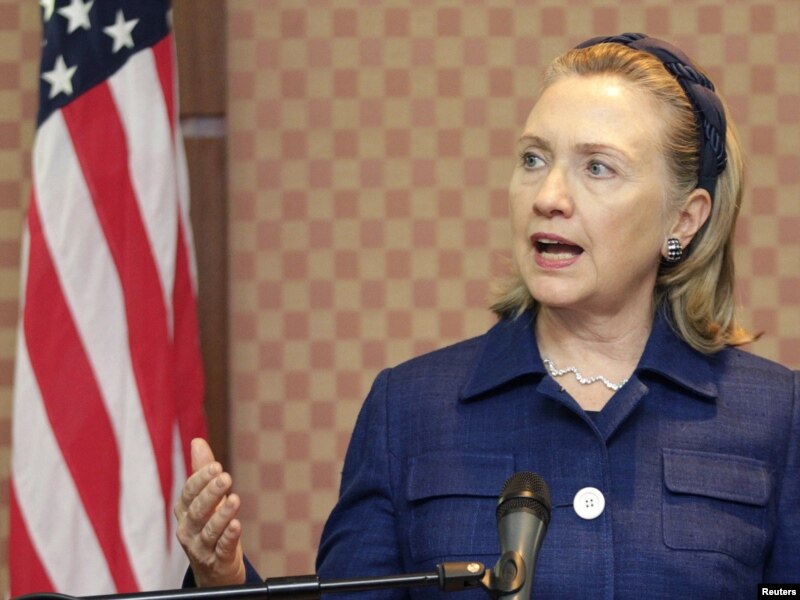
Hillary Clinton Tours Central Asian Countries – Attends OSCE Summit in Kazakhstan

U.S. Secretary of State Hillary Clinton is welcomed by Kazakhstan's Foreign Affairs Minister Kanat Saudabayev on her arrival to Astana
Hillary Clinton arrives to Kazakhstan

On December 1, US Secretary of State, Hillary Clinton, started the diplomatic tour of Central Asian countries by attending summit meeting of the Organization for Security and Cooperation in Europe (OSCE) in Astana, Kazakhstan’s capital.

Also, many heads of government and top foreign affairs officials from across Europe are attending the summit, which is the first top-level meeting of the 56-nation group in 11 years. The group had not gathered since a summit in 1999 in Istanbul. 

The secretary’s next stop is Kyrgyzstan which has been site to considerable political upheaval in recent months. This spring, violence in the small Central Asian republic forced its president Kurmanbek Bakiev to flee to Belarus while the interim government subsequently struggled to hold on to power. Also, hundreds of thousands of people were displaced as a result of the unrest in southern Kyrgyzstan because of ethnic tensions, which the Kyrgyz government blamed ex-president and his son in instigating these tensions. As a result of the ethnic violence, hundreds were killed, thousands injured and more than 2,600 homes destroyed.

Clinton also will visit Uzbekistan, the most populous republic in Central Asia but also less democratic, for the first time in her nearly two years as secretary of state. The country where elections have never been fairly judged by international observers and the executive branch wields most actual power. Dissidents are persecuted. Opposition parties are not allowed to exist and foreign media have been driven out of the country.

Clinton urged the president, Islam Karimov, who has been in power since 1990, “to demonstrate his commitment through a series of steps to ensure that human rights and fundamental freedoms are truly protected.”

The State Department has stated that the Clinton's visit to Uzbekistan as a chance to promote political reform, but it also an opportunity to affirm security cooperation. Uzbekistan is one link in what the United States call their Northern Distribution Network which brings supplies to Afghanistan through Russia and the different  states of Central Asia.

According to the New-York based Human Rights Watch, Clinton should use her impending visits to Kyrgyzstan and Uzbekistan to promote concrete human rights improvements.
  • In Kyrgyzstan she should call for a thorough and impartial investigation into the violence in April and June 2010, fair trials for defendants in cases resulting from the violence, and improved security around the court hearings.
  • In Uzbekistan she should call on the government to free wrongfully imprisoned human rights defenders and journalists and to end repression of civil society.
“Clinton’s meeting with Karimov is a chance for the US to set the record straight on the need to respect rights,” said Rachel Denber, acting Europe and Central Asia director at Human Rights Watch. “Urging the Uzbek government to release imprisoned human rights defenders is a good place to start.”

Human Rights Watch also called on Clinton to urge the Uzbek government to allow the unimpeded operation of nongovernmental organizations, both domestic and international; issue invitations to the eight UN special rapporteurs who have requested access; guarantee freedom of speech and of the media; and implement the conventions against child labor, including by allowing the International Labor Organization to conduct independent monitoring during harvest season.

Friday, November 26, 2010

Uzbek Opposition Leader Dies in The United States

Abdumannop Pulat, leader of the Uzbek opposition and one of the founders of the Birlik party, passed away because of a serious disease in the United States on November 21, 2010.


Pulat died at the age of 59 in Springfield, Virginia. He was born in Tashkent and joined opposition in the mid-1980s when he was a teacher at the Tashkent State University.


The backbone of the Uzbek opposition grew from the university’s 'Journalist' newspaper, published by the journalism department’s students and teachers, who raised political problems and shaped the ideology of a future political movement.

Later the opposition movement split, and the Erk party emerged with poet Muhammad Salih as its leader.

At the same time, President Islam Karimov started strengthening his power and the persecution of opposition leaders began in 1993: some were imprisoned, others were severely beaten up and many had to flee the country.

Abdumannob lived in the United States for 17 years and acquired citizenship in 2001.

Long periods in exile and being unable to return to homeland and work there have deprived Uzbek opposition leaders of opportunities to develop politically and gain experience.

In recent years, Uzbek opposition leaders had disagreements among themselves. They were also unable to unite and achieve a common goal.

Perhaps, dreaming about a free Uzbekistan, Pulat did not assume that he would end up in the USA and die there.

He was buried in Springfield’s Muslim cemetery on November 22.


Link to article: http://uznews.net/news_single.php?lng=en&sub=top&cid=30&nid=15708

P.S. -- I have known Abdumannob Pulat through several interviews that I did online and he always answered my questions on time and with great detail. He will be remembered and missed.

Tuesday, November 23, 2010

Uzbekistan and Iran Named as "Countries of Particular Concern" For Religious Freedom

U.S. Secretary of State Hillary Clinton says advancing religious freedom around the world is a core element of U.S. foreign policy.
U.S. Secretary of State Hillary Clinton says advancing religious freedom around the world is a core 
element of U.S. foreign policy.

November 18, 2010

by Heather Maher

WASHINGTON -- The U.S. State Department says it is "troubled" by the lack of religious freedom in many places throughout the world and has again named Iran and Uzbekistan as "countries of particular concern" that severely restrict citizens' right to practice their faith.

The State Department's annual report on International Religious Freedom, which was released in Washington on November 17, identifies problems and progress in religious freedom in 128 countries during the period from July 1, 2009, to June 30, 2010.

At a press briefing, U.S. Secretary of State Hillary Clinton said that by issuing the report, the United States didn't "intend to act as a judge of other countries or hold [itself] out as a perfect example," but to show that Americans care deeply about religious freedom and consider it a basic human right.

"Religious freedom is under threat from authoritarian regimes that abuse their own citizens. It is under threat from violent extremist groups that exploit and inflame sectarian tensions," Clinton said. "It is under threat from the quiet but persistent harm caused by intolerance and mistrust, which can leave minority religious groups vulnerable and marginalized."

She cited calls by Al-Qaeda for violence against religious minorities in the Middle East, mentioning Sufi, Shi'ite, and Amadiyya holy sites in Pakistan that have been attacked, as well as a Syriac Catholic church in Baghdad.

The U.S. government is also distressed, Clinton said, to receive reports from China of government harassment of Tibetan Buddhists, House church [Chinese] Christians, and Uighur Muslims.

Clinton also noted that "several European countries have placed harsh restrictions on religious expression," but didn't cite any by name.

"These infringements on religious freedom strain the bonds that sustain democratic societies," Clinton said. She said she hoped the report would be a valuable source of information about the state of religious freedom throughout the world and would also serve as "a call to action."

Clinton said the Obama administration's increased focus on engagement with Muslims around the world is an example of how the White House is "advancing religious freedom around the world as a core element of U.S. diplomacy. "

Role Of Free Speech

But the report also objects to the growing trend by countries with majority or significant Muslim populations to lobby the United Nations for resolutions banning the "defamation of religions," saying such language could be used to undermine fundamental freedoms of religion and free speech.

Clinton said the United States "joins in all nations coming together to condemn hateful speech, but [does] not support the banning of that speech."

Iran has again been designated as a "country of particular concern" for efforts by its government to "severely restrict freedom of religion and reports of government imprisonment, harassment, intimidation, and discrimination based on religious beliefs."

"In Iran, government respect for religious freedom continues to deteriorate, especially for groups like the Baha'i," said Assistant Secretary of State Michael Posner.

The report says non-Shi'ite Muslims "faced substantial societal discrimination and government rhetoric and actions created a threatening atmosphere for nearly all non-Shi'a religious groups, most notably Baha'is, as well as Sufi Muslims, evangelical Christians, members of the Jewish community, and Shi'a groups that do not share the government's official religious views."

In addition, it says, "government-controlled broadcast and print media intensified negative campaigns against religious minorities, particularly Baha'is."

Concern For Uzbekistan 

The report also designates Uzbekistan a "country of particular concern," for what Posner said is a declining respect for religious freedom. In the past year, he said, "the government raided Christian and Baha'i services and many members of minority religious groups faced fines or other restrictions."

The report says the government's campaign against religious groups who can't satisfy the strict requirements for official registration includes harassment, detention, and sometimes lengthy jail terms for alleged members.

Specifically, it says, "the number of individuals imprisoned for membership in religious groups labeled extremist such as Nur, a Turkish Muslim group, increased," with an 141 Nur members convicted and sentence to prison terms of between six and 12 years. 

The Uzbek government has also "continued to pursue the extradition of alleged members of religious groups it has deemed Muslim extremist from third countries, particularly from Russia," according to the report.

Monday, November 22, 2010

Uzbek Prisoners Go On Hunger Strike To Protest Treatment

ZHASLYQ, Uzbekistan -- Some 30 inmates of Uzbekistan's notorious Zhaslyq prison have been on a hunger strike since the end of October to protest their treatment, RFE/RL's Uzbek Service reports.


The wives and mothers of several of the inmates on hunger strike told RFE/RL that their loved ones were convicted for religious extremist activity. Some of the inmates' relatives said they had been unable to meet with their husbands and sons for about a month.

They said the prisoners began the hunger strike to protest poor treatment and the pressure exerted on them by prison authorities.

They say their husbands and sons are only guilty of being Muslims who regularly visit a mosque and pray five times a day.

Klara Alimova, who lives in Tashkent, was allowed to see her son, 31-year-old Mirkarim Saidkarimov, on November 20.

She said he told her several inmates were severely beaten by prison guards last month, which prompted the hunger strike.

Zhaslyq is well-known for its very severe and strict regime, and is known in Uzbekistan as "the place of no return." The authorities usually send people sentenced for religious extremism and terrorism to Zhaslyq.

Some half of the prison's 500 inmates have been convicted of belonging to a religious extremist group.

Zhaslyq is located in northwestern Uzbekistan, more than 1,000 kilometers from Tashkent.

Monday, November 15, 2010

Boboev's appeal went unnoticed: Court slaps with upholding previous ruling and a fine of more than $8,000


Abdumalik Boboev
The Tashkent City Court of Appeals upheld the sentence of Voice of America correspondent, Abdumalik Boboev, who has to pay a fine of $8,200.
Judge, Rustam Rasulov, allowed all observers, human rights activists and independent journalists, as well as the United States and the British Embassy officials to attend the hearings on journalist’s appeal.
At the beginning of the hearings, Boboev said that it was a crime to conceal violations of the law from the people and that his duty as a journalist, enshrined in the constitution, was to write the truth about his country.
Boboev's lawyer, Sergey Boboev, said at the trial that no proof of his client’s guilt had been presented at the trial.
Activists unfold their placards to protest against the trial


In fact, the opinion of the expert of the Uzbek Telecommunications and Information Technology Agency’s Center for Monitoring the Media on Boboev’s news reports became a basis for the charges against him. The expert said that his reports pose a threat to public security as it might spread panic among the population.

It turns out Boboev was found guilty and convicted of crimes he had not committed.

Aide to the Tashkent City Prosecutor, Karim Ganibayev, said at the trial that Boboev’s guilt had been proven and urged the judge to uphold the ruling of the Mirzo-Ulugbek Court of October 15, 2010.

As a result, the judge ruled to uphold the journalist’s sentence.

Also, the U.S. embassy in Uzbekistan issued a statement condemning the conviction of Voice of America correspondent, Abdumalik Boboev, which, it said, was unconstitutional.
“Using the criminal justice system to punish journalists for freely expressed views is contrary to Uzbekistan's constitution and international obligations, and has a chilling effect on journalists throughout the country,” the statement said.

Accused journalist against his children becoming journalists in Uzbekistan


06.10.10 23:27
Uznews.net – Hearings into a case against the Voice of America’s only correspondent in Uzbekistan, Abdumalik Boboyev, will start soon. In an interview with Uznews.net, the journalist explains why he had ended up in the dock.

[Q]: You and five other journalists were summoned to the Tashkent city prosecutor’s office on 7 January. What happened then?

[A]: That was an unofficial summons as no-one received a written warrant. They simply called us over the telephone. Initially I decided not to go, but when the guys who went there told me that the prosecutor’s office demanded letters of explanation about our journalistic activities, I wrote one and took it to the prosecutor’s office, but I did not see anyone there.

[Q]: Were you worried about this summons to the prosecutor’s office?

[A]: No, I did not pay attention to it. I just thought that they just wanted to intimidate us, and I continued my work.

[Q]: What happened after that?

[A]: On 5 May I went to Kazakhstan on private business. There was a huge queue near the border post on the Uzbek side. While waiting in the queue to cross the border, I took few photos on my mobile.

People in plain clothes immediately approached and detained me. I spent several hours on the border, and I was later sent to Tashkent Region’s Kibray District police department where I was held for several more hours.

It turned out then that when I went to Kazakhstan on 27 January, an Uzbek border guard for some reason did not stamp my passport to certify that I legally crossed the border crossing and returned to the country.

My documents were seized along with my mobile and voice recorder, and I paid a fine worth some 38,000 sums, and I was set free. On 20 May I received a summons from the prosecutor’s office. They claimed that they needed a photocopy of my passport.

Some time at the beginning of June I submitted my passport to the district passport authorities to receive a new one as there were no pages left for visas. When I went to pick up a new passport, I was told that it had been requested by the prosecutor’s office, which told me – when I went to them – that my passport had been sent to the Uzbek National Security Committee’s Border Service for checking.

[Q] What result has this check produced?

[A]: It dragged until September, when I was summoned by investigator of the Tashkent prosecutor’s office Husan Husanov who told me that he had opened a case against me under Article 223 of the Criminal Code – illegal crossing the border. This did not put me on the alert either, because I had a stamp by the Kazakh Border Service that certified that I crossed the border legally. I was convinced that I could prove my innocence.

[Q]: How did other charges emerge?

[A]: First time I went to the prosecutor’s office without a lawyer.

When I hired a lawyer and went to the prosecutor’s office together, Husanov showed me a resolution on the opening of a criminal case on absolutely different charges that concerned my professional activities as a journalist: libel, slander and producing or distributing materials threatening public security or order.

The last charge is under Part 1 of Article 244 of the Criminal Code. Initially the investigation charged me under Part 1 of this article, but when I refused to made a plea for clemency, the investigator immediately replaced the charges under Part 1 with the charges under Part 3, Items B and C. This means I have allegedly produced and distributed materials threatening public security by abusing my office and using financial support from abroad.

And now I am facing from five to eight years in prison under this article.

The charges are based on an expert opinion formed by the Uzbek Telecommunications and Information Technology Agency’s Centre for Monitoring the Media on the basis of my materials I prepared back in 2009.

None of them contains my personal judgement but they only presented the opinions of representatives of international organisations, civil society, the opposition, independent experts and human rights groups. Moreover, my materials reflected the government’s point of view too – I used information published [officially] to maintain balance.

[Q]: Didn’t you think about leaving Uzbekistan?

[A]: If [the only option is] leaving, then I should have done this earlier. I do not want to flee now. The case was opened and I now have to defend myself.

[Q] What’s the future of journalism in Uzbekistan?

[A]: I think that the number of independent journalists will shrink further, although there are already only few people continuing to work. The authorities do not want to see independent journalists and is open about it. I and my case are the first to be opened against those who were summoned to the prosecutor’s office in January 2010. I think it will be exemplary: what happens to me will happen to others.

[Q]: You have four children. Do you want at least one of them to follow your path and become a journalist?

[A]: No, in the current circumstances I do not want my children to be journalists in Uzbekistan.

Uznews.net’s dossier:

Abdumalik Boboyev was born in the town of Urgut in Samarkand Region in 1969. He graduated from the department of Uzbek philology of the Tashkent State University in 2000.

He started his journalistic career as student in 1997. He worked for national newspapers such as Tong Yulduzi, Turkiston, Uzbekiston Ovozi, Ishonch, Sa’do and Yozuvchi.

In 2000 he started working for the Institute for War and Peace Reporting and Uzbekistan’s first independent website tribuna.uz.

In 2002 he moved to the Voice of America Uzbek Service, and after the service was abolished in 2005 he worked for Uznews.net and in 2006 he resumed his work with the Voice of America.

Boboyev is married and has four children: the youngest is two years and two months old and the eldest is 15 years old.